Free download · no sign-up
Plan your GCSE and International GCSE year with a free toolkit
A printable planning and study toolkit for home-educating families, independent learners and private candidates in the UK. Choose qualifications subject by subject, organise exam entries, plan flexible weeks and track your own progress.
What is inside

Cover 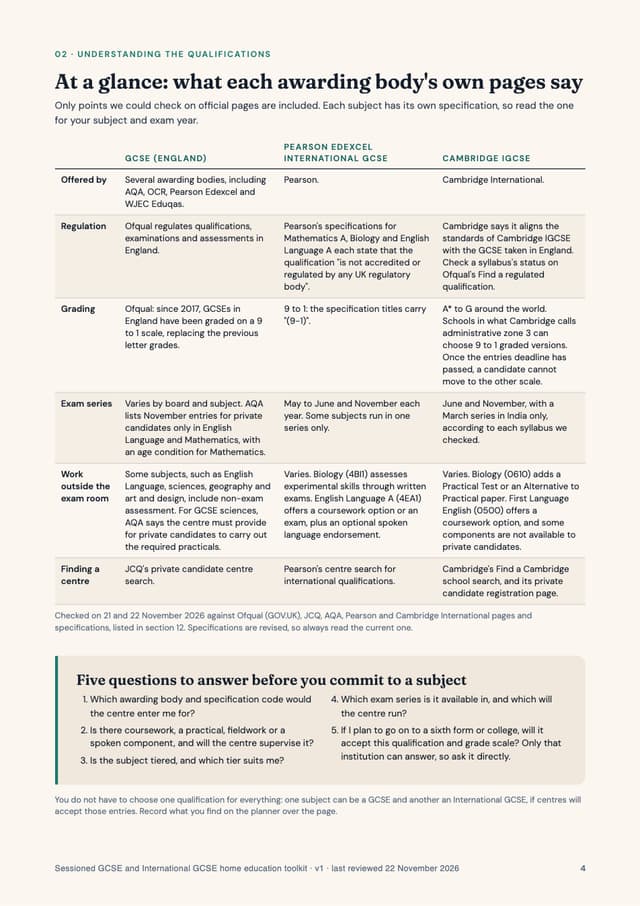
GCSE and International GCSE compared 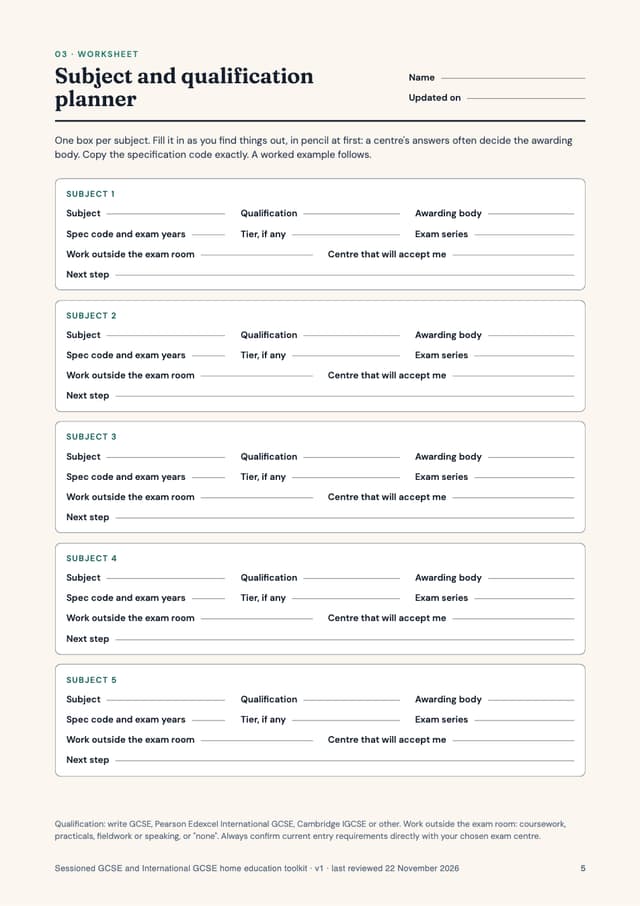
Subject and qualification planner 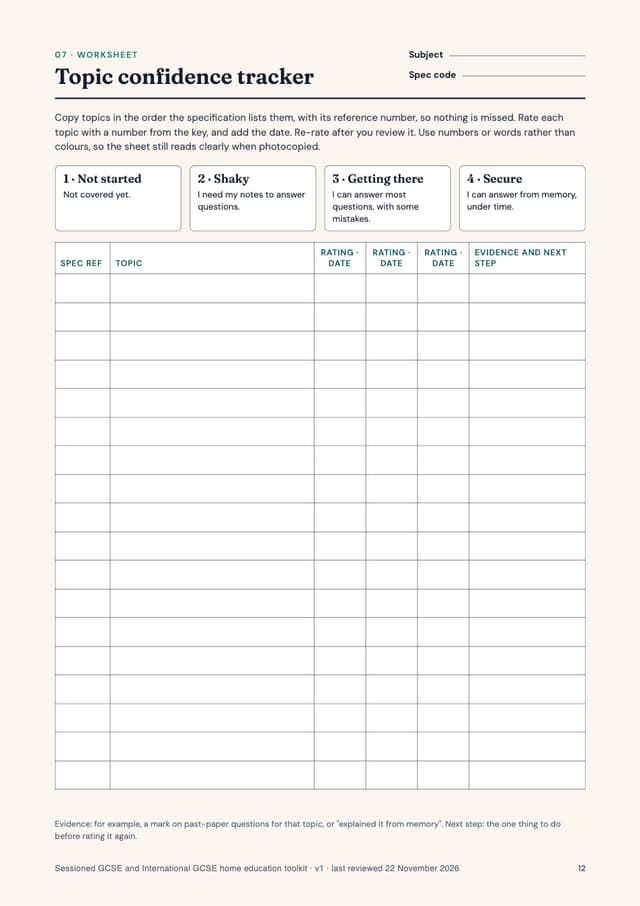
Topic confidence tracker
- A plain-English guideHow GCSE, Pearson Edexcel International GCSE and Cambridge IGCSE differ, and why the awarding body and specification code matter.
- Nine printable worksheetsFrom a subject planner and an exam-entry checklist to goals, weekly planners, trackers and reviews.
- A worked exampleA clearly labelled, invented example of a filled-in subject planner, so you can see how it works.
- A page for parents and carersBuilding independence, avoiding pressure, organising materials and talking to exam centres.
- Official resources, by categoryLinks to Ofqual, JCQ, the awarding bodies and home education guidance for each UK nation.
- Made for real homesNo assumed school timetable, a low-ink version for home printers, and every worksheet as its own PDF.
Who it suits
- Home-educating families planning GCSEs or International GCSEs, whether for one subject or several.
- Independent learners who do most of their studying on their own and want a simple structure.
- Private candidates of any age sitting exams at a centre that is not their own school or college.
- Parents and carers supporting any of the above, including those who are not subject experts.
This toolkit is a planning aid, not an official qualification or an exam-entry service, and Sessioned is not an exam centre. Always confirm current entry requirements directly with your chosen exam centre.
Print a single worksheet
Each worksheet is also a separate PDF on white paper, so you can print a fresh copy whenever you need one.
- Subject and qualification planner2 pages, with a worked example
- Private candidate exam-entry checklist2 pages, with a centre contact record
- Long-term, monthly and weekly goals1 page
- Flexible weekly planner2 pages: structured and flexible versions
- Topic confidence tracker1 page
- Active recall, spaced review and flashcards2 pages
- Practice-question and past-paper log2 pages
- Weekly reflection and monthly review2 pages, with questions to ask a tutor
- Wellbeing check-in1 page
Every section, in brief
A text summary of the toolkit, for reading on screen or with a screen reader.
- 1 Welcome
- 2 GCSE and International GCSE
- 3 Subject planner
- 4 Exam entry
- 5 Goals
- 6 Weekly planner
- 7 Confidence tracker
- 8 Active recall
- 9 Practice log
- 10 Reflection and wellbeing
- 11 Parents and carers
- 12 Resources
1Welcome and how to use the toolkit
Use what helps and skip what does not: there is no right order and no fixed timetable. A quick-start checklist takes you from listing your subjects to your first weekly review.
2GCSE and International GCSE are not the same thing
Their names are similar, but they are different qualifications with their own specifications, assessments and exam series, so choose subject by subject. When someone says “IGCSE”, ask which awarding body they mean, because Pearson and Cambridge set different papers, grading and exam series. Use the exact specification code for each subject, find a centre that will enter you before you commit, and check any coursework, practical or spoken component first.
| Topic | GCSE (England) | Pearson Edexcel International GCSE | Cambridge IGCSE |
|---|---|---|---|
| Regulation | Ofqual regulates qualifications, examinations and assessments in England. | Pearson’s Mathematics A, Biology and English Language A specifications each state the qualification “is not accredited or regulated by any UK regulatory body”. | Cambridge says it aligns Cambridge IGCSE standards with the GCSE in England. Check a syllabus on Ofqual’s Find a regulated qualification. |
| Grading | 9 to 1 since 2017. | 9 to 1. | A* to G worldwide; 9 to 1 versions in what Cambridge calls administrative zone 3. |
| Exam series | Varies by board and subject. | May to June and November; some subjects in one series only. | June and November (March in India only). |
| Finding a centre | JCQ private candidate search. | Pearson’s international centre search. | Cambridge’s Find a Cambridge school. |
Our guide to GCSE, International GCSE and Cambridge IGCSE covers coursework, practicals and speaking in more depth.
3Subject and qualification planner
One box per subject for the qualification, awarding body, specification code and exam years, tier, exam series, any work outside the exam room, and the centre that will accept you. A hypothetical worked example, with an invented learner and invented centres, shows how a mixed plan might look.
4Private candidate exam-entry checklist
Always confirm current entry requirements directly with your chosen exam centre.
A checklist for before you contact centres, finding a centre and checking your entry, with no universal dates or fees, because each centre sets its own process, fees and internal deadlines. A contact record lets you compare up to three centres side by side.
5Long-term, monthly and weekly goals
Start from where you want to be and work backwards, with goals you control, such as “complete and mark two past papers”. A box for when a goal slips: a goal can be moved without being dropped.
6Flexible weekly planner
Two versions: a structured week with blocks you define yourself, and a flexible task list with no days or fixed times. Both have an optional tutor-session slot and a box for adjustments.
7Topic confidence tracker
List topics in specification order, with their reference numbers, and rate each one from 1 (not started) to 4 (secure) with words and numbers rather than colours, so it still reads clearly when photocopied.
8Active recall, spaced review and flashcards
Test yourself before you reread, then come back to each topic at widening gaps: a suggested pattern of the next day, 3 days, a week, 2 weeks and a month. Includes a review schedule and a fold-and-cut flashcard template.
9Practice-question and past-paper log
Match every paper to your exact qualification, awarding body, specification code, tier and paper number, and download papers only from the awarding body’s own website. Our free past paper and specification finder links to each board’s official pages. Pearson says some past papers are available to teachers only, and that private candidates entered for a series can request locked materials.
10Reflection, reviews and wellbeing
A ten-minute weekly reflection, a monthly review, questions to ask a tutor, and a general wellbeing check-in about sleep, energy, time outside and time with people. It is a prompt for noticing and talking, not an assessment, and it signposts the NHS pages on mental health for young people.
11For parents and carers
Building independence step by step, useful questions to ask, avoiding pressure, spotting when extra subject support might help, organising materials and communicating with exam centres. Extra support can come from many places, and a tutor is one option, not a requirement.
12Official resources and next steps
Categorised links to qualification information, exam entry and private candidate pages, the awarding bodies, exam arrangements and home education guidance for England, Wales, Scotland and Northern Ireland, plus a short glossary of the terms you will meet.
Free tools that work alongside it
- Independent study checklistA one-page printable checklist for the year
- Past paper and specification finderOfficial GCSE and International GCSE pages
- Revision timetable builderSpread topics across the weeks you have
- Topic review plannerSpaced reviews, planned for you
- FlashcardsMake and review cards on screen
- Exam countdownWith an exam-day checklist
More free guides are in our home education resources.
Questions about the toolkit
Is the toolkit really free?
Is this an official exam board or exam-entry document?
Does it cover both GCSE and International GCSE?
Does it include exam dates or fees?
Do I need a tutor to use it?
How often is the toolkit reviewed?
Need a little extra support?
If one subject would benefit from one-to-one help, you can request a match or browse tutors, and message a tutor before booking to check they know your awarding body and specification.